
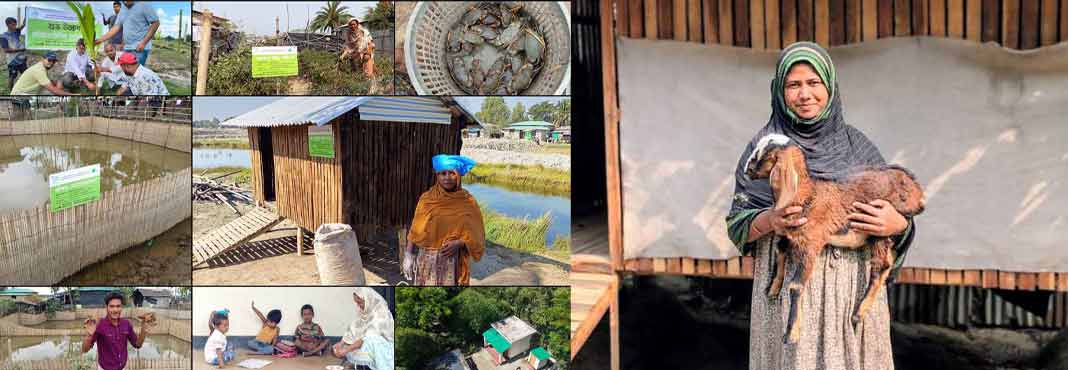
Project Name: Resilient Homestead and Livelihood Support (RHL)
Project Overview
The Resilient Homestead and Livelihood Support to the Vulnerable Coastal People of Bangladesh (RHL) project is a strategic initiative dedicated to bolstering the climate resilience of communities facing extreme environmental risks. By integrating climate-hardy infrastructure with sustainable economic opportunities, the project empowers marginal populations to withstand the escalating impacts of climate change.
In partnership with PKSF, we support disaster-affected communities in Chakaria Upazila, Cox’s Bazar, through emergency response and climate resilience programs.
Core Information
- Project Name: Resilient Homestead and Livelihood Support (RHL)
- Funding Agency: GCF-PKSF
- Implementing Partner: SARPV (Chakaria Upazila)
- Target Districts: Cox’s Bazar, Satkhira, Khulna, Bagerhat, Barguna, Patuakhali, and Bhola.
Project Goals & Objectives
The primary mission is to provide a safety net for vulnerable coastal families through three strategic pillars:
- Resilient Infrastructure: Developing climate-resilient homesteads for marginal communities in the southwest coastal zone.
- Adaptive Livelihoods: Introducing and financing climate-adaptive livelihood technologies that remain productive despite environmental shifts.
- Knowledge & Awareness: Enhancing community understanding of climate change impacts to foster long-term proactive adaptation.
Where We Work: Chakaria Upazila
The RHL project covers a comprehensive network of unions within the Chakaria Upazila to ensure no vulnerable household is left behind.
| Sl. | Union / Area | SL | Union / Area | Upazila | District |
| 1 | Badarkhali | 8 | Purba Boro Veola | Chakaria | Cox’s Bazar |
| 2 | BM Char | 9 | Pachim Boro Veola | ||
| 3 | Harbang | 10 | Saharbil | ||
| 4 | Chakaria Pourashava | 11 | Dhemusia | ||
| 5 | Konakhali | 12 | Chiringa | ||
| 6 | Boroitoli | 13 | Lokkarchar | ||
| 7 | Koiyarbil |
Key Activities
|
|
|
|
|||
|
|
|




Challenges We Are Addressing
Transitioning to climate-adaptive models requires overcoming local barriers:
- Knowledge Gaps: Addressing the lack of technical awareness regarding the potential of crab hatcheries.
- Economic Uncertainty: Helping beneficiaries navigate cost-benefit analyses to prove the long-term profitability of adaptive livelihoods over traditional, high-risk methods.